
Keep Stepping Forward: How to Move Through Life's Hardest Moments
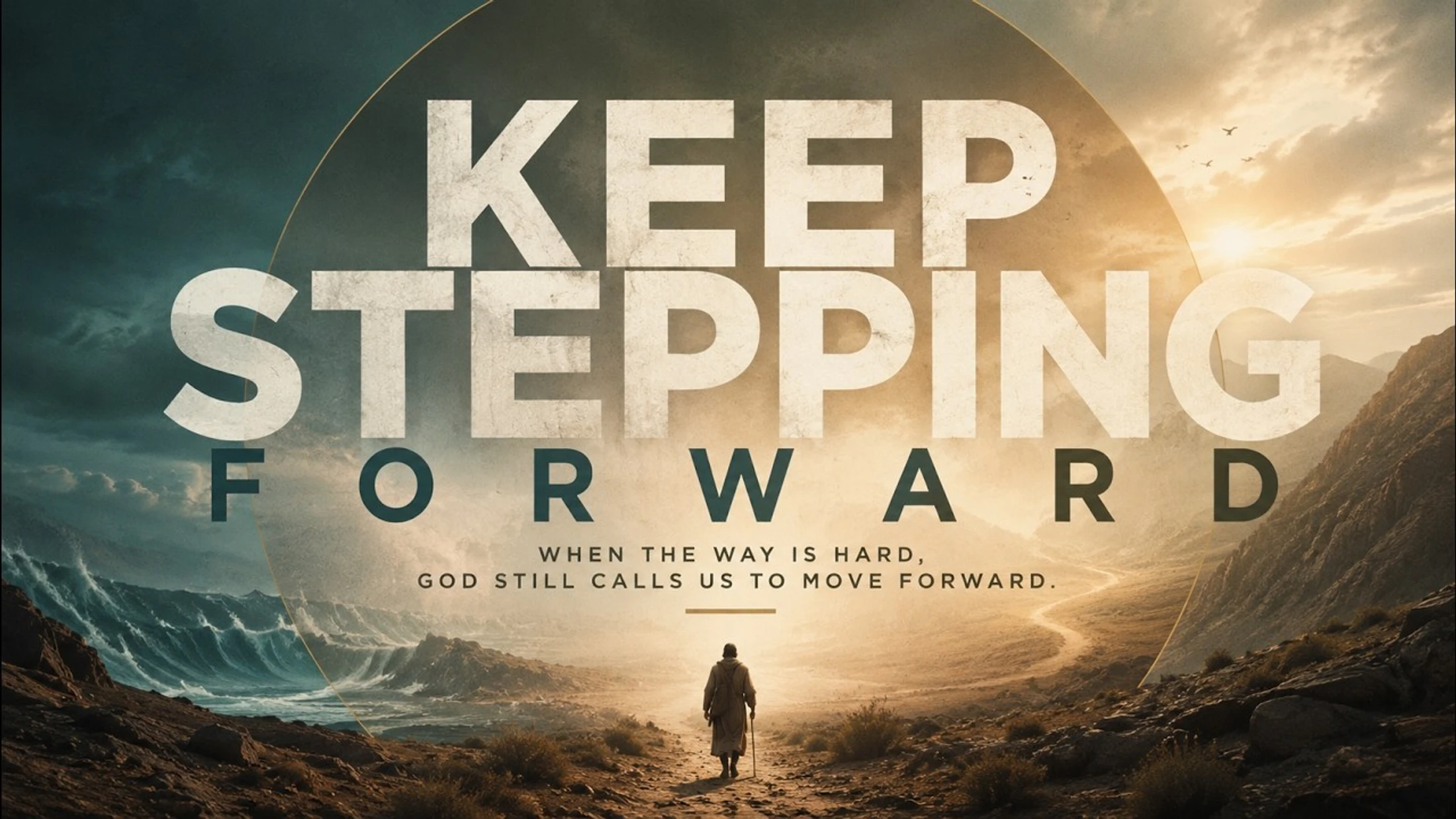
There are moments in life when everything seems to close in at once. The path ahead looks impossible. The mountain is on one side, the sea is on the other, and something relentless is pressing in from behind. In those moments, the most natural human response is to freeze, to look around frantically for an exit, or to simply give up entirely. But what if the answer in those moments was not to retreat, not to collapse, but to keep stepping forward?
That is precisely the message buried in one of the most dramatic scenes in all of Scripture.
Standing at the Edge of the Impossible
In Exodus 14, Moses stands before a terrified crowd of Israelites with the Red Sea stretching out in front of them and the Egyptian army thundering toward them from behind. The people are panicking. The situation, by every human calculation, is hopeless. And yet Moses speaks words that seem almost unreasonable given the circumstances. He tells the people not to be afraid, to stand still, and to watch what God is about to do. Then God speaks directly to Moses with a simple, urgent command: tell the people to go forward.
Go forward. Not backward. Not sideways. Forward.
This is the heartbeat of the passage and a principle that applies to every person who has ever felt cornered by life. God's answer to impossible circumstances is almost never retreat. It is forward motion, taken in faith, one step at a time.
When the World Offers a Different Path
One of the great tensions every believer faces is the constant pull of an alternative path. The world offers its own solutions to pain, its own definitions of success, and its own answers to suffering. It says that when things fall apart, you lower your standards. When the road gets hard, you find an easier one. When hope seems distant, you simply stop hoping.
Moses understood this tension personally. Hebrews 11:24-26 describes how Moses, having grown up with access to the wealth, power, and prestige of Pharaoh's household, made a deliberate choice to walk away from all of it. He chose to identify with the suffering people of God rather than enjoy the temporary pleasures that Egypt could offer. He recognized that what God had for him carried more lasting value than anything the world was placing in his hands.
That same choice presents itself to every believer. The world's path is often wider, more comfortable, and more immediately satisfying. But it leads somewhere far less meaningful. When God calls a person forward, He is calling them away from the easier road and toward something of eternal weight. Choosing God's path over the world's alternative is not a one-time decision. It is a daily commitment to keep stepping in the right direction even when the other road looks more appealing.
The Desert Is Not a Dead End
Perhaps the most difficult season to navigate is what might be called the desert season. These are the stretches of life that feel barren and purposeless. The promotion that never came. The relationship that fell apart. The diagnosis that changed everything. The years of quiet obscurity when it seemed like nothing significant was happening and nothing ever would.
Moses spent forty years in the desert tending sheep after fleeing Egypt. Forty years. For a man who had been educated in the greatest civilization of the ancient world, who had lived inside the halls of power, this was not a small adjustment. It was a complete dismantling of everything he had built his identity around. And yet those forty years were not wasted. They were preparation. Moses learned the desert so thoroughly that he could lead two million people through it. The very season that looked like failure was quietly becoming the foundation for his greatest assignment.
This is one of the most important truths a person can hold onto during a desert season: God does not waste the hard years. He uses them. The loneliness teaches dependence. The silence teaches listening. The stripping away of comfort teaches a person what they are actually made of and what they are actually trusting in. Desert seasons are not dead ends. They are classrooms.
The instruction is not to sit down in the valley. Psalm 23 describes walking through the valley of the shadow of death, not camping there. The valley is something you move through, not something you settle into. Keep walking. Keep stepping. God is doing something in the difficulty that cannot be done any other way.
The Burning Bush Moment
It was in the desert, in Exodus 3:2, that the angel of the Lord appeared to Moses in a flame of fire from the middle of a bush that burned but was not consumed. God met Moses in his most obscure, seemingly forgotten season. Not in the palace. Not on a public stage. In the middle of the wilderness, in the middle of the ordinary work of an ordinary day.
This is deeply encouraging. God does not wait until life is polished and presentable to show up. He meets people in the desert. He meets people in the parking lot after a hard doctor's appointment. He meets people in the grief and the loneliness and the confusion. The burning bush was not a reward for Moses having arrived somewhere impressive. It was God breaking into the middle of an ordinary, difficult season to call a man forward into something far greater than he could have imagined.
The Call to Go Forward
The message of Exodus 14 is not complicated, but it is demanding. It asks something of every person who reads it. It asks that when circumstances look impossible, when the world offers an easier path, when the desert feels endless, and when the future looks uncertain, the response of faith is not to stop.
It is to go forward.
God fights for His people. He makes ways where there are no ways. He uses desert seasons to build what palace seasons never could. He meets the faithful in the wilderness and calls them into their greatest purpose. But He calls them forward, not backward.
Whatever you are facing today, the invitation remains the same. Do not be afraid. Stand firm. And keep stepping forward.